When Sounding Right Becomes Cheaper Than Being Right: What AI Means for Heavy Equipment Buyers, Sellers, and Market Leaders
As AI makes it easier to sound credible than to be correct, heavy equipment buyers and sellers face a new kind of risk. Shae McBride explores why trust, verification and real market data are becoming more valuable—not less.
2026-Jan-Sun

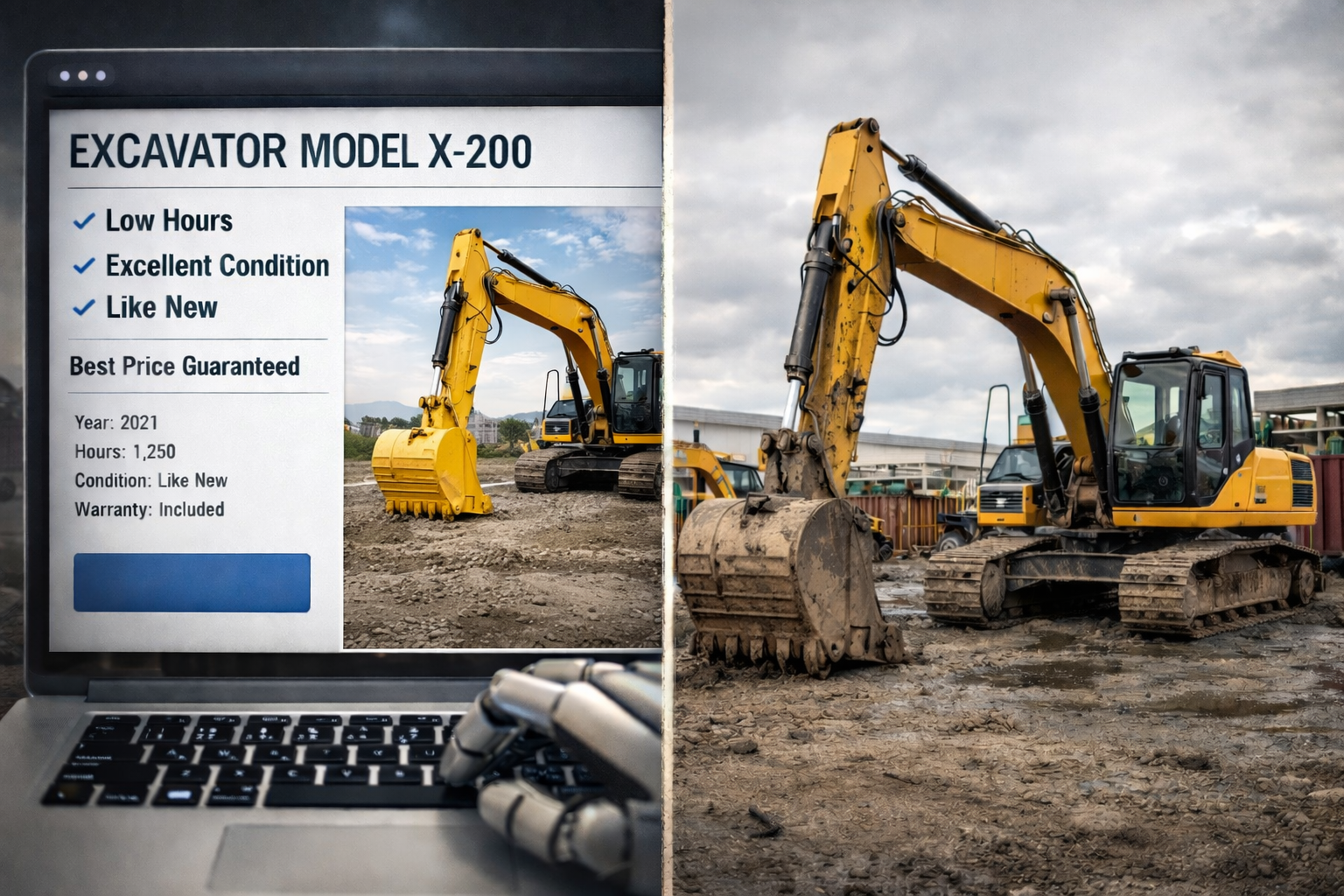
For most of modern business history, honesty had a cost.
It took time to verify equipment specs.
It took experience to assess condition.
And if someone exaggerated or cut corners, it eventually showed up—in reputation, resale value, or relationships.
That friction mattered. It kept markets anchored in reality.
AI is quietly changing that balance.
We are moving into a world where producing something that sounds right is cheaper, faster, and more scalable than producing something that is right. This isn’t about people suddenly becoming less honest. It’s about incentives.
When speed and volume beat verification, truth stops being the default. It becomes something you have to slow down for—and most systems aren’t built to slow down.
Why This Matters in Heavy Equipment and Industrial Markets
In our world, decisions are not small.
A $300K excavator.
A $900K combine.
A multi-million-dollar fleet refresh.
These decisions depend on reliable information—condition, performance, lifecycle cost, and market value. Historically, producing that information required effort and accountability.
AI flips the cost curve.
Modern AI systems don’t know whether something is true. They know whether it sounds plausible. That means:
- A confident-sounding spec can be generated in seconds
- A polished market outlook can be written without ever touching a machine
- An exaggerated claim can spread faster than a correction
Research backs this up. Long before AI became mainstream, MIT researchers found that false information spreads farther and faster than true information. AI doesn’t create that problem—it multiplies it.
The Uncomfortable Reality: Honesty Gets Slower
Here’s the part we don’t talk about enough.
If your competitor uses AI to oversell performance, exaggerate condition, or project certainty they haven’t earned—and you don’t—you may lose attention first.
Not because buyers want to be misled.
But because plausibility travels faster than proof.
That creates a real tension in markets like ours. Accuracy takes time. Verification takes labor. And in an environment optimized for speed, restraint can look like weakness—even when it isn’t.
This Doesn’t End in Chaos. It Ends in Drift.
Truth doesn’t disappear.
It just shows up after decisions are made.
- Claims linger longer than corrections
- Buyers move on before the full picture emerges
- Trust erodes quietly, not dramatically
And humans aren’t built to operate long-term in that environment. When people can’t tell what’s reliable, they disengage—or default to brand, identity, or instinct.
That’s risky in any market. It’s especially risky in markets built on capital equipment, safety, and long-term operating decisions
What a More Stable Market Requires
This isn’t about rejecting AI. We use it every day.
It is about recognizing that some friction is not inefficiency—it’s protection.
A healthier information environment in heavy equipment and industrial markets requires:
- Provenance over polish
- Documentation over confidence
- Transparency over speed
- Human expertise alongside automation
At Catalyst Communications Network, our focus has always been connecting industrial brands with real buyers through trusted channels, credible content, and data grounded in actual market behavior—not just what performs best in an algorithm.
In a world where “sounding right” is cheap, being right becomes a competitive advantage.
Final Thought
AI is accelerating everything—including the cost of getting it wrong.
The companies that win in this next era won’t be the loudest or fastest. They’ll be the ones who can stand behind what they say, prove it when asked, and earn trust over time.
For those of us who buy, sell, build, and operate heavy equipment—that still matters. Catalyst Communications is here to tell your stories and delivery information that is accurate.



Shae McBride (CEO / Founder)